
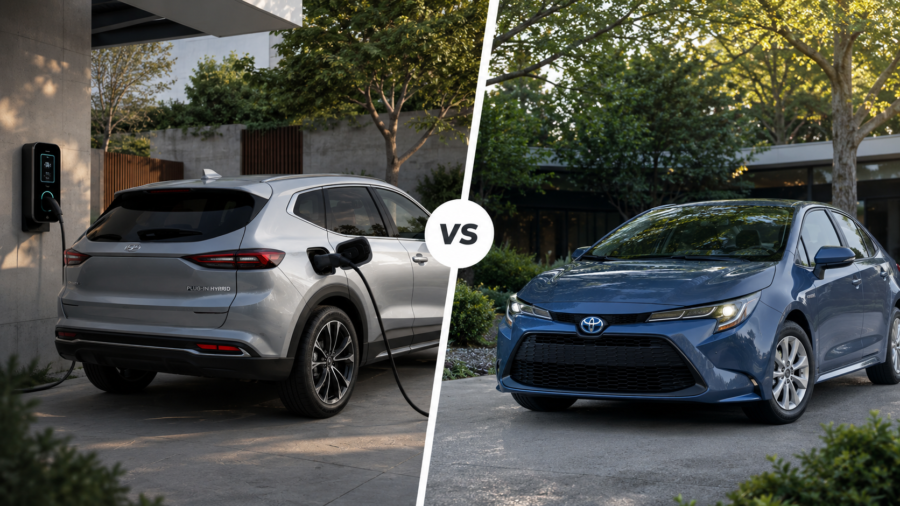
A plug-in hybrid sounds like the perfect middle ground.
It can drive on electric power for shorter trips, but it still has a petrol engine for longer journeys. That means you may get some of the benefits of an electric car without fully depending on public charging.
For many drivers, that sounds ideal.
But a plug-in hybrid is not automatically better than a regular hybrid. It depends on how you drive, where you park, whether you can charge at home and how often you are willing to plug the car in.
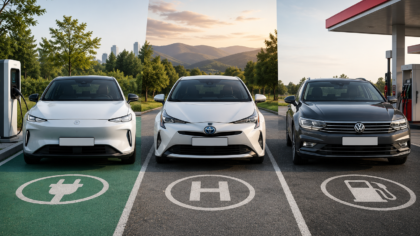
A regular hybrid may be simpler. A plug-in hybrid may be more flexible. A full electric vehicle may be better for some drivers. The right choice depends less on the badge and more on your daily routine.
What Is a Plug-In Hybrid?
A plug-in hybrid, often called a PHEV, is a car that combines a petrol engine with an electric motor and a battery that can be charged from an external power source.
That external charging is the key difference.
A plug-in hybrid can usually drive a certain distance using electric power before the petrol engine is needed. For short commutes, school runs or local errands, some drivers may use very little petrol if they charge regularly.
When the battery runs low, the petrol engine can take over. This gives the car more flexibility on longer journeys, especially for drivers who are not ready to rely fully on charging stations.
In simple terms, a plug-in hybrid tries to offer two things at once: electric driving for daily trips and petrol backup for longer drives.
What Is a Regular Hybrid?
A regular hybrid also combines a petrol engine with an electric motor and battery, but it does not need to be plugged in.
The car manages the battery by itself. It can recover energy during braking and use electric assistance in traffic, at low speeds or when extra efficiency is useful.
A regular hybrid usually cannot drive as far on electric power alone as a plug-in hybrid. Its battery is smaller, and the electric system is mainly there to support the engine rather than replace it for longer stretches.
The advantage is simplicity.
You drive it like a normal petrol car. You fill it at a fuel station, and the hybrid system works in the background. There is no charging routine to manage.
For drivers who want better fuel economy without changing habits, a regular hybrid can be easier to live with.
The Main Difference: Charging
The biggest difference between a plug-in hybrid and a regular hybrid is charging.
A plug-in hybrid needs regular charging to deliver its biggest benefits. If you charge it at home or at work and most of your journeys are short, you may drive many local miles on electric power.
A regular hybrid does not need charging. It is always ready to use in the same way as a conventional car, but with better efficiency in many driving situations.
This makes the choice very practical.
If you can charge easily, a plug-in hybrid may be useful. If you cannot charge easily, a regular hybrid may make more sense.
A plug-in hybrid that is rarely plugged in can lose much of its appeal. It may still work as a petrol-hybrid car, but the larger battery and extra hardware may not deliver the real-world savings people expect.
When a Plug-In Hybrid Makes Sense
A plug-in hybrid can make sense if your daily driving is mostly short and predictable.
For example, if you drive a short commute, take children to school, go shopping locally and can charge at home overnight, a PHEV may let you do many trips using mostly electric power.
It can also work well for drivers who want an electric-like experience during the week but still take longer road trips where petrol backup feels reassuring.
This is the main appeal of the technology.
You do not have to plan every long journey around chargers, but you can still reduce fuel use during shorter trips.
A plug-in hybrid may also suit people who are interested in EVs but not fully ready to buy one. It can act as a stepping stone toward electric driving.
When a Regular Hybrid May Be Better
A regular hybrid may be better if you cannot charge at home or work.
It may also be better if you do not want to think about charging at all. For many drivers, that simplicity is valuable.
Regular hybrids can be especially useful for city driving and stop-start traffic, where the electric motor can assist more often. They also avoid some of the planning that comes with plug-in vehicles.
If you live in an apartment, park on the street or do not have reliable access to charging, a regular hybrid may offer a more realistic efficiency improvement.
It may not deliver as much electric-only driving as a PHEV, but it also does not rely on you plugging it in.
The Plug-In Hybrid Trap
The biggest mistake with plug-in hybrids is buying one and rarely charging it.
A PHEV only works at its best when the battery is used properly. If it is treated like a normal petrol car, the benefits can shrink. The car may still be comfortable and useful, but the electric side of the system becomes underused.
This matters because plug-in hybrids are often more complex than regular hybrids.
They carry a larger battery, charging hardware and a petrol engine. That can make them heavier and sometimes more expensive than a regular hybrid.
The technology is not the problem. The mismatch is the problem.
A plug-in hybrid is a good fit for some routines and a poor fit for others.
Is a Plug-In Hybrid Cheaper to Run?
A plug-in hybrid may be cheaper to run if you charge regularly and use electric power for many short trips.
But it is not guaranteed.
Costs depend on electricity prices, fuel prices, charging access, driving style, insurance, servicing, purchase price and how long you keep the car.
If you mostly use public fast charging, the savings may be smaller. If you rarely charge, the car may use petrol more often than expected. If the PHEV costs much more than a regular hybrid, it may take longer to recover that difference.
This is why drivers should not judge only by official fuel economy numbers.
Real-world use matters more.
Before choosing a plug-in hybrid, ask yourself: will I actually plug it in several times a week?
If the honest answer is no, a regular hybrid may be the safer choice.
How Plug-In Hybrids Compare With Full EVs
A full electric vehicle has no petrol engine. It depends completely on battery power and charging.
That can be excellent for drivers with home charging and predictable daily routes. EVs can be smooth, quiet and cheaper to run in many situations.
But some drivers are not ready for that step.
They may worry about charging on long trips, public charger reliability or buying a car without petrol backup. For them, a plug-in hybrid can feel less risky.
However, a PHEV is also more mechanically complex than a full EV. It has both an engine and an electric system. That means it is not simply a smaller EV with a backup tank. It is its own type of vehicle with its own trade-offs.
A full EV may be better if you can charge easily and want to avoid petrol entirely.
A plug-in hybrid may be better if you want some electric driving but still need long-distance flexibility.
What Drivers Should Check Before Buying
Before choosing between a plug-in hybrid and a regular hybrid, start with your parking situation.
Can you charge at home? Can you charge at work? Is there a reliable charger near your regular routine? If charging is difficult, a plug-in hybrid may become inconvenient.
Next, look at your daily distance. If most of your trips are short, a PHEV may cover many of them on electric power. If you mostly drive long motorway journeys, the benefit may be smaller.
Then compare the price difference. A plug-in hybrid may cost more to buy than a regular hybrid. Check whether the extra cost makes sense for your usage.
Also check boot space and cabin practicality. Batteries can affect space in some models.
Finally, test the car in normal driving. A good hybrid should feel smooth, easy and predictable. If the system feels confusing, keep comparing.
Which One Should Most Drivers Choose?
There is no single answer.
A plug-in hybrid is better for drivers who can charge regularly and want electric driving for short trips with petrol backup for longer journeys.
A regular hybrid is better for drivers who want improved fuel economy without charging.
A full EV is better for drivers who can charge easily and are ready to move away from petrol entirely.
The mistake is choosing based only on trends.
Plug-in hybrids are not automatically the perfect compromise. Regular hybrids are not outdated. EVs are not right for every household yet. Each option solves a different problem.
The best choice is the one that fits your real life.
Final Takeaway
A plug-in hybrid can be a smart choice, but only for the right driver.
If you can charge regularly and most of your daily trips are short, a PHEV may let you use electric power often while keeping petrol backup for longer journeys.
If charging is difficult or you do not want to plug in, a regular hybrid may be simpler and more practical.
The key is honesty.
Do not buy a plug-in hybrid just because it sounds like the best of both worlds. Buy one if your routine actually lets you use both worlds properly.
For many drivers, the future of car buying is not a simple choice between petrol and electric. It is about choosing the level of electrification that fits daily life, budget and confidence.

Comments
You can write your views about this story. Comments may be moderated according to site settings.