
Electric and hybrid cars can feel different the first time you drive one.
Sometimes the car slows down more strongly when you lift your foot off the accelerator. In some models, you may barely need to touch the brake pedal in normal traffic. In others, the slowing effect is gentle and almost invisible.
That difference often comes from regenerative braking.
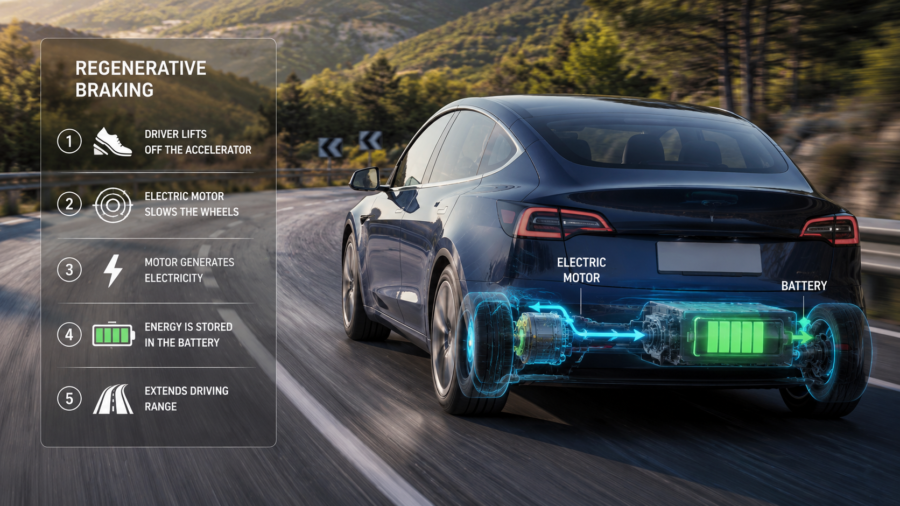
The name sounds technical, but the idea is simple. Instead of wasting all the energy created when a car slows down, an electric or hybrid vehicle can capture some of that energy and send it back to the battery.
This helps improve efficiency. It can also change the way the car feels on the road.
For drivers moving from a petrol car to an EV or hybrid, regenerative braking is one of the first technologies worth understanding.
What Is Regenerative Braking?
Regenerative braking is a system that helps an electrified car recover energy while slowing down.
In a traditional petrol car, braking usually turns movement into heat through friction brakes. The brake pads press against the discs or drums, the car slows down, and much of that energy is lost as heat.
In an electric or hybrid vehicle, the electric motor can help slow the car. When that happens, the motor can act like a generator. It captures some of the car’s moving energy and sends it back to the battery.
The car still has normal brakes. Regenerative braking does not fully replace them. But during everyday slowing, it can reduce how much the friction brakes need to work.
That is why EVs and hybrids can feel smoother and more efficient in stop-and-go driving.
Why It Matters in EVs and Hybrids
Regenerative braking matters because electric and hybrid vehicles are designed to use energy carefully.
Every time a car slows down, there is energy involved. A normal braking system simply gets rid of that energy as heat. A regenerative system tries to reuse part of it.
In an electric vehicle, recovered energy can help support driving range. It will not magically refill the battery, but it can make the car more efficient, especially in city traffic.
In a regular hybrid, regenerative braking is even more important because the car cannot be plugged in. The hybrid system uses braking and engine operation to help keep the battery charged.
In a plug-in hybrid, regenerative braking can also help, but the main battery charge usually comes from plugging the car into an external power source.
The benefit depends on the car, road, battery level and driving style. But the basic purpose is always the same: waste less energy while slowing down.
Why EVs Can Feel Different When You Lift Off the Accelerator
Many EVs slow down noticeably when you lift your foot off the accelerator.
This can surprise new drivers.
In a petrol car, lifting off the accelerator usually reduces speed gradually. In some electric cars, lifting off can create a stronger slowing effect because the car begins recovering energy through regenerative braking.
Some models let drivers choose the strength of this effect. A low setting may feel closer to a normal petrol car. A high setting may slow the car more strongly and recover more energy.
This is not necessarily better or worse. It is a different driving feel.
Some drivers love it because it makes city driving easier. Others prefer a more traditional coast-and-brake style. The best setup is the one that feels natural and safe to the person behind the wheel.
What Is One-Pedal Driving?
One-pedal driving is a driving mode found in some electric vehicles.
It allows the driver to accelerate by pressing the pedal and slow down strongly by lifting off it. In normal traffic, the driver may use the brake pedal much less often.
The car still has a brake pedal, and the driver must use it when needed. One-pedal driving does not remove the need for normal braking, especially in emergencies.
But it can make everyday driving feel smoother.
In city traffic, one-pedal driving can reduce the constant movement between accelerator and brake. The driver can control speed more with one pedal, while the car recovers energy during slowing.
Some people adjust to it quickly. Others need time. Anyone new to one-pedal driving should practice gently in a safe, low-speed environment before relying on it in busy traffic.
Regenerative Braking Does Not Replace Normal Brakes
This is an important point.
Electric and hybrid vehicles still use conventional brakes. Regenerative braking is helpful, but it cannot handle every braking situation by itself.
If the driver needs to stop quickly, the normal brakes are still needed. If the battery is full, the car may reduce regenerative braking because there is less room to store recovered energy. If the road is slippery or conditions are unusual, the car may blend regenerative and friction braking differently.
That is why drivers should never assume regenerative braking alone will stop the car in every situation.
The brake pedal still matters.
Modern vehicles manage this automatically, but the driver should understand the basics. Regenerative braking is an efficiency tool, not a reason to pay less attention.
Why Regeneration Can Feel Stronger or Weaker
Regenerative braking does not always feel the same.
It can change depending on battery level, driving mode, temperature, speed and road conditions. Some cars also let drivers choose different regeneration settings.
For example, regeneration may feel weaker when the battery is nearly full. That is because the battery has limited space to accept more energy. It may also feel different in cold weather, depending on how the battery system manages temperature.
Some cars show this clearly on the dashboard. Others make the change feel more automatic.
This is why drivers may notice that their EV or hybrid does not always slow down in exactly the same way.
That does not necessarily mean something is wrong. But if braking behavior feels unsafe, inconsistent or unusual, the driver should have the vehicle checked.
Does Regenerative Braking Save Money?
Regenerative braking can help reduce energy use, but it is not a magic money-saving feature on its own.
Its biggest benefit is efficiency. In an EV, it can help stretch battery energy in everyday driving. In a hybrid, it helps the car use its electric system more effectively.
It may also reduce wear on friction brakes because the traditional brakes are used less often during gentle slowing. However, brake wear still depends on driving style, vehicle design, road conditions and maintenance.
Drivers should not buy an EV or hybrid only because of regenerative braking. It is one useful part of a larger system.
The real savings depend on the car’s overall efficiency, energy costs, fuel costs, charging habits and maintenance.
City Driving Is Where It Often Helps Most
Regenerative braking is especially useful in stop-and-go traffic.
City driving involves frequent slowing, stopping and starting. That gives the system more chances to recover energy.
On long highway trips, there may be fewer braking events. The car cruises at steady speed, so there are fewer opportunities for regeneration. In that situation, aerodynamics, speed, battery efficiency and driving behavior may matter more.
This is why hybrids often perform well in city driving compared with traditional petrol cars. The electric system can help during low-speed movement and recover energy during braking.
For drivers who spend a lot of time in urban traffic, regenerative braking can become a noticeable part of the vehicle’s efficiency.
What New EV Drivers Should Know
New EV drivers should take time to understand how their car handles regenerative braking.
Start by checking the driving modes. Some cars have low, medium and high regeneration. Others have a one-pedal mode. Some use paddles behind the steering wheel to adjust the effect.
Try the settings in a calm area before using them in heavy traffic.
Pay attention to how the car slows when you lift off the accelerator. Learn when you still need the brake pedal. Do not assume the car behind you expects your vehicle to slow quickly without obvious movement from your foot.
Also remember that brake lights may behave differently depending on the car and regeneration strength. Modern EVs are designed to manage this, but driving smoothly still matters.
The goal is not to maximize regeneration at all times. The goal is to drive safely and comfortably.
What Hybrid Drivers Should Know
Hybrid drivers may not notice regenerative braking as strongly as EV drivers.
In many regular hybrids, the system works quietly in the background. The car may feel mostly normal, but it is still recovering energy during braking.
Some hybrid dashboards show when energy is flowing back to the battery. This can help drivers understand how smooth braking and gentle acceleration affect efficiency.
Plug-in hybrid drivers should remember that regeneration is useful, but charging is still the main way to get electric range. A PHEV that is never plugged in will not deliver its full benefit, even if it uses regenerative braking.
For hybrid owners, the best approach is simple: drive smoothly, brake gently when safe and let the system do its job.
Common Misunderstandings
One common misunderstanding is that regenerative braking fully recharges the car.
It does not.
It recovers some energy that would otherwise be lost, but it cannot replace plugging in an EV or PHEV. It is a support system, not a full charging solution.
Another misunderstanding is that stronger regeneration is always better.
Strong regeneration can recover more energy in some situations, but it may not always feel smooth. Some passengers may find aggressive one-pedal driving uncomfortable if the driver is not gentle.
A third misunderstanding is that regenerative braking means normal brakes are unnecessary.
That is not true. Conventional brakes remain essential for safety and certain braking situations.
Final Takeaway
Regenerative braking is one of the key reasons electric and hybrid cars feel different to drive.
It allows the vehicle to recover some energy while slowing down, sending that energy back to the battery instead of wasting it all as heat. This can improve efficiency, reduce brake use in gentle driving and make city traffic feel smoother.
But it is not magic.
Regenerative braking does not replace normal brakes. It does not fully recharge the car. It can feel different depending on battery level, settings and road conditions.
For drivers, the best approach is to understand how the system works in their specific vehicle.
Once you get used to it, regenerative braking can make an EV or hybrid feel more natural, efficient and controlled. It is one of the small technologies that quietly changes the way modern cars are driven.

Comments
You can write your views about this story. Comments may be moderated according to site settings.