
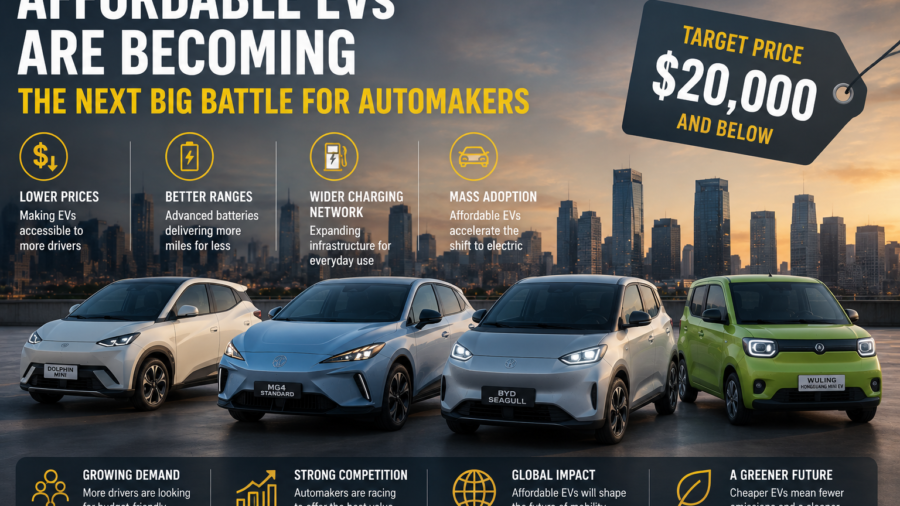
Electric vehicles are no longer only about range, fast charging and futuristic design.
The next big battle is price.
For years, EVs were often presented as the future of driving, but many ordinary buyers still saw them as expensive. Even when running costs looked attractive, the upfront price could feel too high compared with petrol, diesel or hybrid alternatives.
That is now becoming one of the most important problems automakers need to solve.
Drivers are interested in electric cars, but interest does not always turn into a purchase. A car still has to fit a household budget. It has to make sense as a family vehicle, a commuter car or a practical second car. It has to feel reliable, supported and easy to live with.
That is why affordable EVs are becoming the next big battle in the car industry.
The brands that can offer electric vehicles at realistic prices may shape the next stage of EV adoption.
Why EV Affordability Matters Now
Electric vehicle sales are still growing globally, but the market is becoming more practical.
Early EV buyers were often willing to pay more for new technology. They liked the idea of driving electric, and many had home charging or enough flexibility to adjust their routine.
The next wave of buyers may be different.
They may like EVs but still compare them carefully with hybrids or petrol cars. They may ask simple questions: Is the monthly payment reasonable? Can I charge easily? Is the range enough? Will the car still be valuable in a few years? Can I get service nearby?
For these buyers, affordability is not only about the sticker price. It is about the full ownership experience.
A cheaper EV that feels limited, poorly supported or difficult to charge may not win people over. A slightly more expensive EV with good range, reliable software and clear warranty support may feel like better value.
The real battle is not just “cheap EVs.” It is useful, trustworthy and affordable EVs.
Battery Costs Are a Key Part of the Story
The battery is one of the most expensive parts of an electric car.
When battery costs fall, automakers have more room to lower prices, improve range or add features. When battery material costs rise, that pressure becomes harder to manage.
This is why battery technology matters so much to affordable EVs.
Carmakers are looking for ways to reduce cost without making the car feel compromised. That can mean using different battery chemistries, improving manufacturing efficiency, sharing platforms across multiple models or offering smaller battery options for drivers who do not need long range.
Not every driver needs a giant battery.
A city driver who mostly travels short distances may prefer a cheaper compact EV with enough range for daily use. A family that takes long motorway trips may need more range and faster charging. Affordable EVs will need to serve different needs instead of pretending one battery size fits everyone.
Why Smaller EVs Could Become More Important
Large electric SUVs have received a lot of attention, but smaller EVs may be more important for mass adoption.
A compact electric car can be easier to park, cheaper to build and more efficient in daily driving. It may not offer the longest range or the biggest cabin, but it can make sense for city commuters, young drivers, small families and people looking for a second car.
This is especially important in Europe and other markets where small cars are common.
For many drivers, the ideal affordable EV is not a luxury crossover. It is a simple, safe and efficient car that handles school runs, commuting, shopping and weekend trips without costing too much.
The challenge is making small EVs profitable.
Automakers need to keep prices down while still meeting safety rules, software expectations and customer demand for modern features. That is not easy, especially when competition is intense.
Chinese Automakers Are Increasing Price Pressure
Chinese automakers are a major reason the affordable EV conversation is becoming more urgent.
Many Chinese brands have grown quickly by focusing on electric vehicles, battery supply chains, competitive pricing and fast product cycles. Some are now expanding more visibly in Europe and other international markets.
This puts pressure on established automakers.
If newer brands can offer well-equipped EVs at lower prices, traditional carmakers need to respond. They may need to reduce costs, build new platforms, simplify production or offer more competitive entry-level models.
For drivers, this competition can be positive. More competition can mean better prices, more features and faster innovation.
But it can also make the market more confusing. Buyers may see unfamiliar brands offering attractive deals and wonder whether service, parts, resale value and software support will be strong enough over time.
A low price matters, but trust still matters too.
Traditional Automakers Are Trying to Catch Up
Established automakers are not ignoring the affordability problem.
Many are working on lower-cost EV platforms, smaller electric models and more efficient production systems. Some are investing in local manufacturing or shared platforms to reduce cost and compete more directly with newer rivals.
This is not only about building cheaper cars.
It is about protecting market share.
If mainstream buyers decide that EVs are too expensive, they may delay switching or choose hybrids instead. If they find affordable EVs from newer brands, traditional automakers may lose customers they once considered loyal.
That is why affordable EVs are now a strategic priority.
The automaker that wins this space will not simply be the one with the most advanced technology. It will be the one that combines price, range, quality, software and support in a way ordinary drivers can trust.
Affordable Does Not Mean Basic Anymore
A major change in the car market is that buyers expect more, even from lower-priced vehicles.
Drivers want good safety equipment, a decent screen, smartphone support, efficient heating and cooling, useful driver-assistance features and reliable navigation. EV buyers may also expect charging information, route planning and over-the-air software updates.
This makes affordable EVs harder to build.
A car cannot simply be cheap and stripped down. It still needs to feel modern.
That does not mean every affordable EV needs luxury features. But it should not feel outdated from day one. The best affordable models will likely focus on the features drivers actually use, while avoiding expensive extras that do not add much daily value.
Simple can be good.
Cheap-looking is different.
Charging Still Affects Affordability
The price of the car is only one part of EV affordability.
Charging access can change the whole equation.
If a driver can charge at home on a cheaper electricity rate, an EV may feel more affordable over time. If that same driver depends on expensive public fast charging, the savings may be smaller.
This is why affordable EVs need to be discussed together with charging infrastructure.
A low-cost electric car is more attractive when drivers can charge easily, predictably and at a reasonable cost. Without that, some buyers may choose a hybrid instead.
Public charging reliability, payment simplicity and charger location all play a role. If the charging experience feels uncertain, the cheapest EV may still feel like a risky purchase.
For EVs to become truly mainstream, affordable cars and reliable charging need to grow together.
The Used EV Market Will Also Matter
New affordable EVs are important, but the used market may be just as important.
Many drivers do not buy new cars. They buy used vehicles after the first owner has taken the biggest depreciation hit. If more good EVs enter the used market at reasonable prices, electric driving can become accessible to a much wider group.
But used EV buyers need confidence.
They need clear information about battery health, warranty coverage, charging history and software support. If the used EV market feels confusing, buyers may avoid it even when prices look attractive.
Better battery reports, longer warranties and clearer dealer information could help.
Affordable EV adoption will not only depend on what automakers sell new. It will also depend on how those cars age.
What Drivers Should Watch For
Drivers interested in affordable EVs should look beyond the lowest price.
Range matters, but it should match real use. A shorter-range EV may be perfectly fine for daily commuting but frustrating for frequent long trips.
Charging speed matters, but charger access matters more. A car that charges quickly is less useful if nearby chargers are unreliable or expensive.
Software matters too. A clear dashboard, good route planning and regular updates can make a budget EV feel much easier to live with.
Warranty and service support are also important. A new or unfamiliar brand may offer a strong price, but buyers should check service locations, parts availability and long-term support.
A good affordable EV should feel practical, not like a compromise you regret later.
Why This Battle Is Good for Drivers
The push toward affordable EVs could be good news for ordinary buyers.
It may bring more choice, better prices and more practical electric cars. It may also force automakers to stop treating EVs as premium-only products and start designing them for everyday budgets.
That could help electric vehicles move from early adopters to mainstream households.
But the transition will not happen overnight.
Some affordable EVs will be better than others. Some will cut costs in smart ways. Others may feel too limited. Drivers will need to compare carefully and avoid judging only by headline price.
The best affordable EVs will be the ones that make electric driving feel normal.
Final Takeaway
Affordable EVs are becoming the next major battleground for automakers because price is now one of the biggest barriers to wider electric vehicle adoption.
Many drivers are interested in EVs, but they need cars that fit real budgets, real charging conditions and real family needs.
Lower battery costs, stronger competition, Chinese automaker expansion and new small EV platforms are all pushing the market toward more affordable options.
That does not mean every cheap EV will be a good buy.
Drivers should still compare range, charging access, software, safety, warranty, service support and long-term value. The future of EV adoption will not be decided only by who can build the cheapest car.
It will be decided by who can build an electric car that ordinary people can afford, trust and use without making daily life more complicated.


Comments
You can write your views about this story. Comments may be moderated according to site settings.