
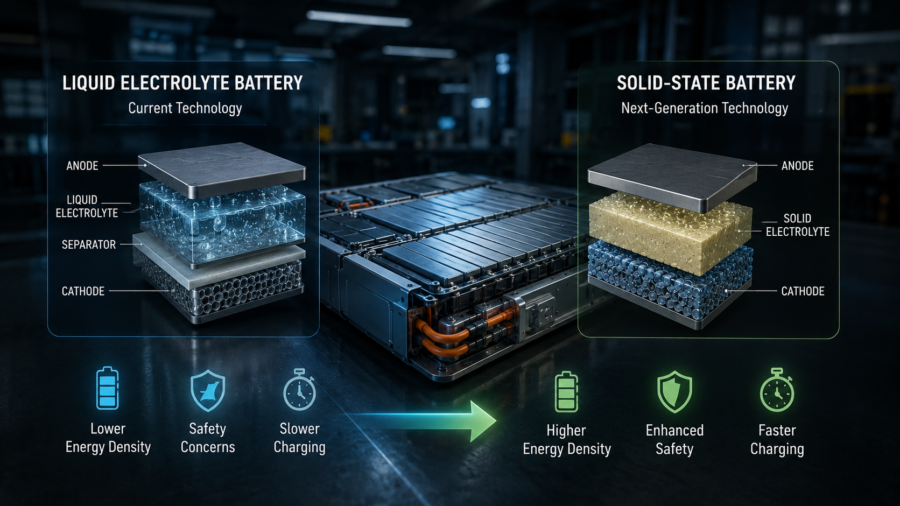
Solid-state batteries are one of the most talked-about technologies in the electric vehicle world.
The promise sounds huge: longer driving range, faster charging, improved durability and potentially safer battery packs. For drivers who are interested in EVs but still worry about charging time and range, that sounds like exactly the kind of breakthrough the market needs.
But solid-state batteries are not magic.
They are not about to make every electric car cheap, lightweight and ultra-fast charging overnight. Automakers and battery companies are making real progress, but mass production is still difficult, expensive and technically demanding.
That is why solid-state batteries are exciting and complicated at the same time.
They may shape the next generation of electric vehicles, but drivers should understand what they are, why they matter and why the timeline is still uncertain.
What Is a Solid-State Battery?
A solid-state battery is a battery that uses a solid electrolyte instead of the liquid or gel electrolyte used in many current lithium-ion batteries.
The electrolyte is the material that helps ions move inside the battery during charging and discharging. In today’s common EV batteries, this part of the battery is usually liquid-based. In a solid-state battery, it is solid.
That difference may sound small, but it can change how the battery performs.
Solid-state designs may allow higher energy density, which means more energy can be stored in the same amount of space. They may also support faster charging and improved stability, depending on the materials and design.
In simple terms, a solid-state battery could help an EV go farther without making the battery pack much larger.
That is why automakers care so much about the technology.
Why EV Makers Are Interested
Electric vehicles are already improving, but batteries still shape many of the biggest buying concerns.
Drivers ask how far the car can go, how long it takes to charge, how long the battery will last and how much the car costs. Automakers know that better batteries can answer many of those questions at once.
A battery with higher energy density could increase range. A battery that handles charging better could reduce long-trip waiting time. A battery that lasts longer could improve resale confidence. A battery that is easier to package could give designers more freedom.
This is why solid-state batteries are seen as a possible next step.
They are not just another feature. They could affect range, design, performance, safety and cost over time.
But only if companies can build them reliably at scale.
The Big Promise: More Range
One of the biggest hopes for solid-state batteries is longer range.
Range is still one of the most important numbers in EV marketing. Even drivers who rarely use the full battery often feel more confident when a car offers a comfortable range buffer.
Solid-state batteries may help because they can potentially store more energy in a smaller or lighter package.
That could create two different benefits.
Automakers could build EVs with longer range without making the battery pack much bigger. Or they could keep the range similar while using a smaller, lighter battery, which may improve efficiency and reduce material use.
The second option may be just as important as the first.
Not every driver needs extreme range. Many people need affordable EVs that are efficient, practical and not too heavy. Solid-state batteries could help with that in the long term if production costs come down.
Faster Charging Is Another Goal
Charging speed is another reason solid-state batteries get attention.
Many EV drivers charge at home most of the time. For them, overnight charging can be easy. But long journeys still depend on public charging stops, and that is where faster charging becomes important.
If solid-state batteries can safely handle higher charging speeds, road trips may become easier.
A shorter charging stop can make an EV feel closer to the experience of a petrol or hybrid car. Instead of planning long waits, drivers may stop for a coffee or short break and continue.
However, charging speed is not only about the battery.
The charger, the car’s thermal management, battery temperature, state of charge and charging network all matter. Even if a future battery can charge faster, the real-world experience will still depend on the full system.
A better battery helps, but it does not solve every charging problem by itself.
Safety and Stability Could Improve
Solid-state batteries are often discussed as potentially safer because they replace liquid electrolytes with solid materials.
Liquid electrolytes in current batteries can be flammable under certain conditions. Battery safety has already improved a lot in modern EVs, but companies continue to look for designs that reduce risk further.
A solid electrolyte may improve stability and reduce some safety concerns, depending on the specific chemistry.
But it is important not to oversimplify this.
A solid-state battery still needs careful engineering. It still stores a large amount of energy. It still needs protection systems, temperature management and strong manufacturing quality.
The technology may offer safety advantages, but safe EVs are built through the whole battery system, not one material change alone.
The Hard Part: Mass Production
The biggest challenge is not proving that solid-state batteries can work in a lab.
The challenge is making millions of them reliably, affordably and consistently.
Automotive batteries need to survive years of charging, discharging, vibration, temperature changes and daily use. They must meet safety standards and be produced at enormous scale.
That is difficult.
Solid-state batteries can face problems such as material durability, manufacturing complexity, cost and maintaining good contact between battery layers during repeated use. Even small defects can matter when the battery is part of a vehicle that people depend on every day.
This is why many companies talk about pilot lines, demonstration vehicles and phased production.
The technology is moving forward, but going from promising prototype to mass-market product is a major step.
Why Timelines Keep Moving
Drivers often hear that solid-state batteries are “just a few years away.”
Sometimes that is true for limited production or early models. But widespread availability can take longer.
There is a difference between launching a small number of vehicles with advanced batteries and making the technology common across affordable mainstream cars.
Early solid-state batteries may appear first in premium models, limited production vehicles or demonstration fleets. That would allow automakers to test performance, reliability and customer experience before scaling up.
Mainstream adoption may take more time because cost and manufacturing scale matter so much.
This does not mean the technology is fake or overhyped. It means battery manufacturing is hard.
A future technology can be real and still take years to become affordable for ordinary buyers.
What Solid-State Batteries Could Mean for Affordable EVs
Solid-state batteries are often connected with premium performance, but their long-term impact may also be affordability.
If the technology eventually reduces material use, improves efficiency or simplifies battery packaging, it could help lower costs. But that is not guaranteed in the early years.
New battery technology is often expensive at first.
The first solid-state EVs may not be the cheapest electric cars on the market. They may arrive in higher-end vehicles where buyers are willing to pay more for range, charging speed or advanced engineering.
Over time, if manufacturing improves, costs may come down.
That is when solid-state batteries could matter most for everyday drivers. Not when they appear in a few expensive cars, but when they help make practical EVs better and more accessible.
How This Compares With Today’s Lithium-Ion Batteries
Today’s lithium-ion batteries are not standing still.
They continue to improve in cost, durability, charging speed and energy density. Different chemistries, such as lithium iron phosphate batteries, are also helping automakers build more affordable EVs.
This means solid-state batteries do not need to replace every current battery immediately.
Instead, the EV market may use several battery types for different needs. Some cars may use lower-cost batteries for affordable models. Some may use high-performance lithium-ion packs. Some future models may use solid-state technology where the benefits justify the cost.
That variety is normal.
The future of EV batteries is unlikely to be one single solution for every car.
What Drivers Should Expect
Drivers should be interested in solid-state batteries, but not wait forever for them.
If you need a car today, current EVs, hybrids and plug-in hybrids already offer many practical options. Waiting for a perfect future battery may not make sense if an existing vehicle fits your routine.
But if you are watching the EV market for a future purchase, solid-state batteries are worth following.
They could improve range, charging time and long-term confidence. They could also push current battery makers to keep improving, which benefits buyers even before solid-state becomes common.
The best attitude is balanced optimism.
Solid-state batteries are promising, but drivers should judge real cars when they arrive, not only laboratory claims or concept announcements.
What to Watch Next
There are three things worth watching.
First, whether automakers can move from pilot production to real customer vehicles. Announcements are useful, but production scale is the real test.
Second, whether early solid-state EVs deliver clear real-world benefits. Longer range and faster charging need to show up in everyday driving, not only in technical presentations.
Third, whether the technology becomes affordable. A battery breakthrough matters most when ordinary drivers can buy the cars that use it.
Battery progress is one of the most important parts of the EV transition, but it will happen in stages.
Final Takeaway
Solid-state batteries could become one of the most important technologies in the next generation of electric vehicles.
They may help EVs go farther, charge faster, last longer and use space more efficiently. That is why automakers and battery companies are investing so much effort into the technology.
But mass production remains the hard part.
The first solid-state EVs may arrive in limited numbers before the technology becomes common. Costs, durability, manufacturing quality and supply chains still need to improve.
For drivers, the message is simple: solid-state batteries are worth watching, but they are not a reason to ignore the EVs and hybrids already available today.
The future of electric cars may be better because of solid-state batteries, but that future will arrive step by step, not all at once.


Comments
You can write your views about this story. Comments may be moderated according to site settings.