
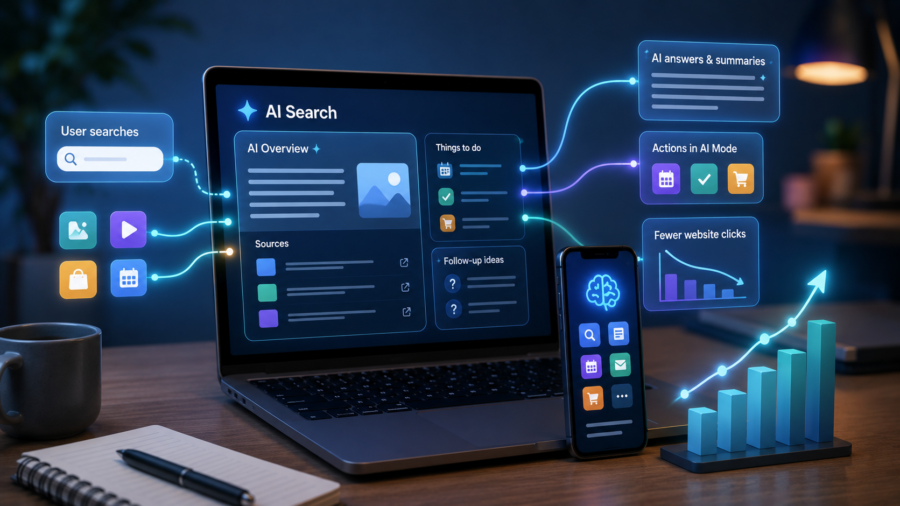
Website traffic is changing because users are no longer always clicking through a list of links.
For years, the web worked in a familiar way. A person searched for something, clicked a result, visited a website and read the answer there. Publishers, bloggers, businesses and creators built their traffic strategies around that behavior.
AI Search changes that pattern.
Search engines are starting to answer more questions directly. AI apps can summarize information, compare options, complete tasks and send users to fewer websites. AI agents can monitor topics, connect to apps and help users act without browsing in the old way.
That does not mean websites are dead. But it does mean website owners need to understand a new reality: traffic may become harder to win from simple informational searches.
What is AI Search
AI Search means search results that use generative AI to understand questions, summarize information and sometimes help users complete tasks.
Instead of showing only traditional blue links, AI Search may show a generated summary, suggested next steps, follow-up questions, product comparisons, planning tools or agent-style actions.
Google described its 2026 Search updates as a new era for AI Search, bringing advanced model capabilities into Search and enabling users to use agents by asking questions. Google also called the new AI-powered Search box one of the biggest upgrades to Search in more than 25 years.
This is important because the search result page is becoming more interactive.
Users may not need to click as often for basic answers. They may stay inside the search experience longer.
How AI Mode changes user behavior
Google’s AI Mode is designed for more complex and conversational searches.
At I/O 2026, Google said AI Mode can connect with apps such as Gmail and Google Photos, with Google Calendar support coming later. Google says users remain in control and choose if and when to connect these apps.
That matters because search is no longer only searching the public web.
If a user connects personal apps, AI Search can help with more context-aware tasks. It may help plan, compare, summarize or organize based on both web information and personal data.
This makes search feel more like an assistant.
For websites, the challenge is clear. If the search interface gives users enough information or action steps, fewer users may click through to a separate page.
Why publishers are worried
Publishers are worried because their business models often depend on traffic.
If AI summaries answer questions directly, users may not visit the original article. That can reduce ad revenue, newsletter signups, affiliate clicks and brand exposure.
Reuters reported that the UK Competition and Markets Authority is requiring Google to give publishers more control over whether their content appears in AI-driven Search features, while still allowing traditional search listings. The regulator also wants clearer attribution and direct links in AI results.
This shows that AI Search is not only a technology issue. It is also a media, business and competition issue.
Publishers want visibility, but they also want traffic and control over how their content is used.
Why simple informational content may lose clicks
The content most exposed to AI Search disruption is simple informational content.
For example, if a user asks a basic question such as “what is a VPN?” or “how many days do I need in Cappadocia?”, AI Search can often summarize the answer quickly.
If the summary is enough, the user may not click a website.
This does not mean informational content has no value. It means the content needs to offer more than a basic answer.
Websites may need to provide stronger examples, original experience, better visuals, clearer comparisons, fresh data, expert context, tools, checklists or local detail that AI summaries cannot fully replace.
Why Discover may become more important
As traditional search clicks become harder, Google Discover may become more valuable for some publishers.
Discover works differently from normal search. Users do not always start with a query. Instead, content appears based on interests, freshness, relevance and engagement signals.
Search Engine Land reported earlier in 2026 that while AI Overviews may reduce traditional organic clicks, some publishers still saw opportunities in breaking news and Discover growth.
For a site like soeasy.blog, this matters.
Discover-friendly content should be useful, timely, visually strong and easy to understand. It should not be thin, generic or written only for keywords.
The best strategy is not to chase AI Search only. It is to build content that can work in Search, Discover, social sharing and direct return visits.
How AI apps also affect traffic
AI apps can change traffic in another way.
Users may ask AI apps for answers instead of searching the web. They may ask a chatbot to compare travel destinations, summarize app updates, explain a car feature or recommend steps for a task.
That means some traffic may never reach search engines at all.
AI agents make this even more important. If an agent monitors a topic or completes a task in the background, the user may only see the final result.
TechCrunch reported that Google is adding AI-powered information agents that can monitor topics and proactively alert users to updates. This kind of feature could reduce the need for repeated manual searches.
For websites, the question becomes: how do you remain useful when users rely more on AI assistants
What kind of content can still win
Content can still win if it gives users something AI summaries cannot easily replace.
That includes fresh reporting, firsthand testing, original images, expert interviews, personal experience, clear comparisons, local knowledge, practical checklists and real examples.
For soeasy.blog, the strongest content types are likely:
Simple explainers of new AI and app features
Travel decision guides with clear comparisons
Automotive software and EV buying explainers
Online safety guides with practical steps
Business-tech stories explained for normal readers
How-to guides with screenshots or step-by-step logic
AI Search may summarize generic answers. But it is harder to replace helpful, well-structured, experience-rich content.
Why brand trust matters more now
When traffic becomes more competitive, brand trust matters more.
If users remember a site and trust its explanations, they may return directly. They may search for the site by name. They may subscribe, bookmark or follow it through Discover.
This is why websites should not rely only on keyword traffic.
A site needs a clear identity.
For soeasy.blog, the identity should be simple: easy guides and trend explainers for AI, apps, technology, travel, cars and digital life.
That is more memorable than a generic news site trying to cover everything.
Why websites should avoid AI-only generic content
AI Search makes generic AI-written content less valuable.
If a site publishes basic summaries with no added value, AI systems can produce similar summaries directly. Users have little reason to click.
That means websites need to be more careful, not less.
Content should be edited, structured and useful. It should answer real user questions. It should include context, limitations and practical advice. It should avoid clickbait and unsupported claims.
Google’s own guidance has long emphasized creating helpful content for people rather than content made only to perform in search. That becomes even more important in the AI Search era.
How app content can adapt
Apps content can adapt well because users often want practical explanations.
For example, a search summary can say that Android has fake call detection. But a useful article can explain what it does, who gets it, what the limits are, how it affects scams and what users should still do.
A summary can say Apple is expected to improve Siri. A useful article can explain how that may change app usage, privacy and developer integrations.
This is the difference between information and usefulness.
Apps content should focus on what changes for the user.
How travel content can adapt
Travel content can still do well if it helps users decide.
AI can list destinations, but users still need judgment.
They want to know whether Antalya or Bodrum fits their holiday style. They want to know how many days to spend in Cappadocia. They want to know whether Turkey still offers good value in 2026. They want practical differences, not just a list of places.
Travel articles should include comparisons, season advice, traveller types, realistic pacing and useful warnings.
That is harder for a short AI summary to replace.
How business-tech content can adapt
Business-tech content should explain what company news means for ordinary readers.
A cloud deal is not interesting by itself. But it becomes interesting if it explains why social apps need more AI infrastructure.
An AI chip selloff is not useful as stock commentary. But it becomes useful if it explains rising expectations for AI hardware.
An enterprise AI agent deal is more useful when it explains how business software is changing.
This is the right approach for soeasy.blog: make complex business-tech stories easy to understand.
What website owners should do in 2026
Website owners should not panic, but they should adapt.
First, reduce dependence on thin informational search traffic.
Second, build stronger topic clusters. Related articles should link naturally to each other.
Third, use clear titles and useful excerpts, not vague clickbait.
Fourth, create visuals that match the article exactly.
Fifth, build direct audience habits through newsletters, bookmarks, social channels or return visits.
Sixth, monitor Search Console and Discover performance separately.
AI Search may reduce some search clicks, but strong content can still reach users through multiple channels.
What this means for soeasy.blog
For soeasy.blog, the AI Search shift actually supports the current strategy.
The site should not behave like a general news site. It should publish clear, useful, visually strong explainers around AI, apps, travel, automotive, business-tech and digital life.
The best content should answer one practical question:
What does this trend mean for the reader
That is the type of content people are more likely to click, read and share.
It is also the type of content that can survive better when AI summaries handle basic facts.
The bigger takeaway
AI Search and AI apps could change website traffic in 2026 by giving users more answers and actions before they ever click a website.
Search is becoming more conversational. Apps are becoming more agent-like. AI assistants are becoming more capable of summarizing, planning and acting.
This creates real pressure for publishers and website owners.
But it also creates an opportunity.
Websites that publish generic summaries may lose value. Websites that provide clear explanations, original context, practical comparisons and trustworthy guidance can still matter.
The future of traffic will not only belong to the sites that chase keywords. It will belong to the sites that users recognize as useful.
For soeasy.blog, that means simple, helpful, well-structured content that makes technology and digital life easier to understand.

Comments
You can write your views about this story. Comments may be moderated according to site settings.