
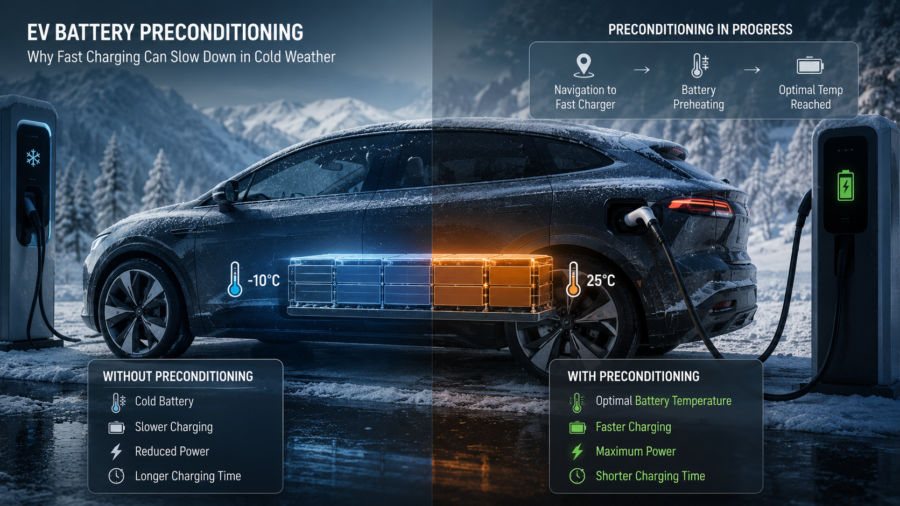
Electric cars can be easy to live with when the weather is mild and charging is predictable.
But in cold weather, some drivers notice something different. Range may drop. Fast charging may take longer. Regenerative braking may feel weaker. The car may need more energy just to warm the cabin and battery.
This is where EV battery preconditioning becomes important.
The phrase sounds technical, but the idea is simple. Battery preconditioning prepares the battery before driving or before fast charging, usually by warming or cooling it to a better working temperature.
For drivers, this can make an EV feel more reliable in winter and more efficient at a fast charger.
It does not solve every cold-weather problem. It also does not mean every EV behaves the same way. But understanding preconditioning can help drivers get better results from an electric car, especially on cold mornings and long road trips.
What Is EV Battery Preconditioning?
EV battery preconditioning is a system that adjusts the battery temperature before the car needs to perform at its best.
In cold weather, the battery may be too cold to deliver or accept energy efficiently. In very hot conditions, it may also need cooling to protect performance and battery health.
Preconditioning helps bring the battery closer to its preferred operating range.
This can happen before driving, before fast charging or while the car is navigating to a charging station. Some EVs do this automatically when a fast charger is selected in the navigation system. Others let drivers schedule cabin and battery preparation before leaving.
The exact system depends on the car.
For the driver, the simplest explanation is this: preconditioning helps the battery get ready before it is asked to work hard.
Why Batteries Dislike Cold Weather
EV batteries are based on chemical reactions. When the temperature drops, those reactions can happen more slowly.
That can affect both driving and charging.
In cold weather, an EV may use more energy to heat the cabin. The battery may also be less efficient, which can reduce range. Fast charging may slow down because the car protects the battery from accepting too much power while it is too cold.
This is why two EV charging sessions can feel very different.
A car may charge quickly on a mild day after a long drive, but more slowly on a freezing morning when the battery is cold.
The charger may not be the problem. The car may simply be limiting charging speed because the battery is not warm enough.
How Preconditioning Helps Fast Charging
Fast charging works best when the battery is at the right temperature.
If the battery is too cold, the car may restrict how much power it accepts. That can make a high-power charger feel slower than expected.
Battery preconditioning can reduce that problem.
When the car knows you are heading to a fast charger, it may begin warming the battery before you arrive. By the time you plug in, the battery may be closer to the temperature needed for faster charging.
This does not guarantee maximum charging speed. Charging speed still depends on the charger, the car, the battery percentage, temperature, battery design and charging network conditions.
But preconditioning can help the car reach better charging performance than it would with a cold battery.
Why Navigation Matters
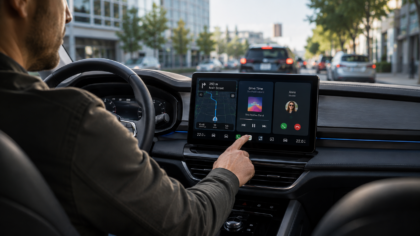
In many EVs, preconditioning works best when the charging stop is entered into the car’s built-in navigation system.
That is because the car needs to know where you are going and when you may arrive. If it sees that you are heading to a compatible fast charger, it can start preparing the battery at the right time.
If you simply drive to a charger without telling the car, preconditioning may not happen automatically.
This is one reason EV route planning matters.
A driver may think, “I know where the charger is, so I do not need navigation.” But the car’s battery system may benefit from having that destination selected.
Not every EV works this way, so drivers should check their vehicle manual. But for many modern electric cars, using built-in navigation before fast charging can make a real difference.
Preconditioning Before Driving
Preconditioning is not only about fast charging.
Many EVs also allow drivers to precondition the cabin before departure. In cold weather, this can warm the interior while the vehicle is still plugged in.
That can be useful because cabin heating uses energy. If the car warms itself while still connected to external power, more battery energy may be saved for driving.
Some vehicles can also warm the battery before driving, which can improve performance and regenerative braking in cold conditions.
For daily use, scheduled departure settings can be helpful. A driver can set the car to be ready at a certain time, with the cabin warm and the battery better prepared.
This is especially useful for commuters who leave at the same time each morning.
Does Preconditioning Use Energy?
Yes, preconditioning uses energy.
Warming or cooling a battery does not happen for free. The car must use electricity to run heaters, pumps or thermal management systems.
But that energy use can still be worthwhile.
If the car is plugged in, preconditioning can use grid power instead of drawing heavily from the battery after departure. If the battery is being prepared for fast charging, the energy used to warm it may help reduce time spent waiting at the charger.
The goal is not to avoid energy use completely. The goal is to use energy at the right time so the car performs better when needed.
This is why preconditioning while plugged in is usually more useful than waiting until the battery is already cold and the car is on the road.
When Drivers Should Use Battery Preconditioning
Battery preconditioning is most useful in a few situations.
The first is cold-weather driving. If your EV has scheduled departure or cabin preconditioning, using it before leaving can make the car more comfortable and may help preserve driving range.
The second is DC fast charging. If you plan to use a fast charger, entering the charger into the built-in navigation system can help the car prepare the battery if the vehicle supports that feature.
The third is long road trips. Preconditioning can make charging stops more predictable, especially in winter.
The fourth is extreme weather. Very cold or very hot temperatures can both affect battery performance, so thermal management becomes more important.
For short daily trips in mild weather, preconditioning may not matter as much. The benefit depends on conditions.
What Preconditioning Cannot Do
Preconditioning is useful, but it has limits.
It cannot make a cold-weather EV behave exactly like it does in perfect temperatures. It cannot fix a broken charger. It cannot guarantee maximum charging speed. It cannot remove the effect of wind, snow, tire pressure, heating use or high-speed driving.
It also cannot change the basic design of the car’s battery and charging system.
Some EVs charge faster than others. Some manage temperature better. Some have heat pumps. Some have more advanced route planning. These differences matter.
Preconditioning is one tool inside the larger EV experience.
Drivers should treat it as helpful preparation, not a magic button.
Common Mistakes EV Drivers Make
One common mistake is arriving at a fast charger with a cold battery and expecting the highest charging speed.
The car may not allow it.
Another mistake is using a third-party map app instead of the car’s built-in navigation when heading to a fast charger. The route may still work, but the car may not precondition the battery if it does not know a fast charger is the destination.
A third mistake is ignoring scheduled departure settings in winter. Drivers who have home charging may get better comfort and efficiency by warming the cabin while plugged in.
Another mistake is comparing charging sessions without considering temperature. A slow winter session does not always mean the charger is bad. Battery temperature and state of charge can both affect speed.
What to Check in Your EV
If you drive an EV, check how your specific model handles preconditioning.
Look for settings related to scheduled departure, climate preparation, battery heating, winter mode or navigation-based charging preparation.
Check whether the car preconditions automatically when a fast charger is selected. Also check whether the feature works with all chargers or only certain charging networks.
If you use home charging, see whether you can schedule preconditioning before your usual departure time.
If you often use fast chargers, learn whether the car shows a battery heating or preconditioning indicator. Some vehicles make this clear, while others do it quietly in the background.
The details vary, so the owner’s manual and official app settings are worth reviewing.
Why This Feature Will Matter More
Battery preconditioning will become more important as EVs move beyond early adopters.
New EV buyers want the car to feel predictable. They do not want to learn complicated charging tricks or guess why the car is charging slowly.
Better preconditioning systems can make EV ownership easier by preparing the battery automatically and explaining what is happening clearly.
This is especially important in colder markets, where winter range and charging speed are common concerns.
As cars become more software-defined, automakers may also improve battery preparation through updates, route planning and smarter thermal management.
The best EVs will not only have good batteries. They will help drivers use those batteries well.
Final Takeaway
EV battery preconditioning helps prepare the battery for driving or fast charging, especially when the weather is cold.
It can warm the battery before a fast charging stop, improve comfort before departure and make winter EV driving feel more predictable. It is most useful when the car is plugged in before driving or when a fast charger is selected in the vehicle’s built-in navigation system.
But it is not magic.
Charging speed still depends on the car, charger, battery percentage, weather and battery design. Preconditioning also uses energy, so it works best when used at the right time.
For EV drivers, the lesson is simple: learn how your car prepares its battery.
That small habit can make cold-weather driving and fast charging easier, calmer and less frustrating.
Comments
You can write your views about this story. Comments may be moderated according to site settings.