
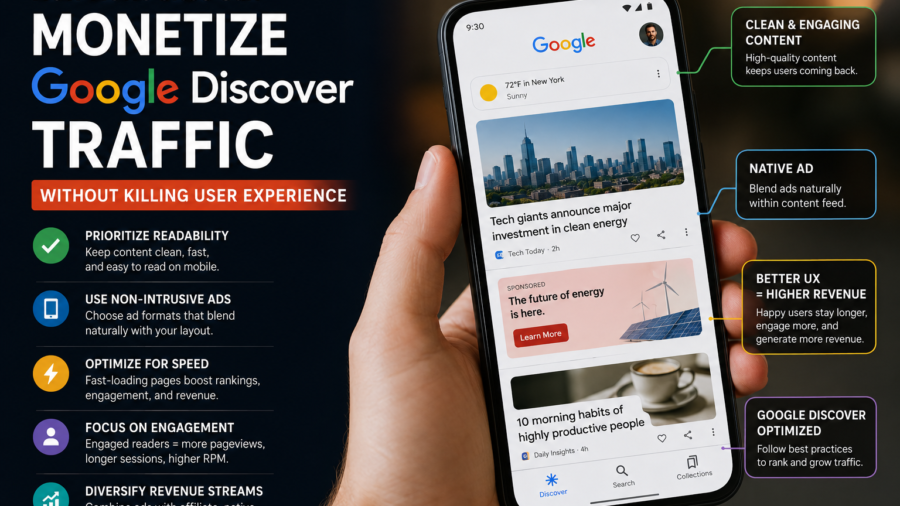
Google Discover traffic can feel exciting for a news site.
One article starts getting clicks. Mobile traffic rises. The analytics dashboard moves faster than usual. A story that was published a few hours ago suddenly reaches thousands of readers who were not searching for it directly.
For publishers, that kind of traffic can create a real monetization opportunity.
But Discover traffic also creates a temptation: add more ads quickly and try to earn as much as possible before the traffic fades.
That can be a mistake.
If ads block the article, slow the page, cover the first screen or frustrate mobile readers, the site may damage the same audience it is trying to monetize. Google Discover is heavily mobile-driven, and mobile readers are quick to leave when a page feels messy.
The goal is not to avoid ads completely.
The goal is to monetize Discover traffic in a way that keeps the article readable, fast and trustworthy.
Disclosure: This article contains a sponsored affiliate link. If you register through the link below, we may receive a commission at no extra cost to you.
Start Monetizing With Adsterra
Why Google Discover Traffic Is Different
Google Discover is not the same as normal search traffic.
Search traffic usually comes from users typing a query. They have a clear question or need. Discover traffic is more interest-based. Readers see stories that Google thinks may match their interests, recent activity or content preferences.
That means Discover readers may be curious, but they may also be less committed.
They did not always search for your site. They may not know your brand. They may tap because the headline and image caught their attention.
This makes the first few seconds very important.
If the page loads slowly, the image feels misleading or the article is hard to read, the reader may leave quickly. If the page feels clean and useful, they may keep reading, visit another article or remember the site later.
Discover traffic can be powerful, but it needs a smooth mobile experience.
The Content Must Come First
A news site should not treat Discover traffic as only an ad opportunity.
The content still matters most.
Readers want a clear headline, a strong opening, short mobile-friendly paragraphs and useful context. They do not want to scroll through ads before understanding the story.
This is especially important for second-wave stories.
A second-wave story does not simply repeat the first breaking news update. It explains what happened, why it matters, what is confirmed, what is not confirmed and what readers should understand next.
That kind of article can perform well because it gives readers more value than a thin rewrite.
Monetization works better when the page gives users a reason to stay.
Protect the First Screen
The first screen of a Discover article should be clean.
Readers should quickly see the headline, featured image or opening section, and the beginning of the article. If the top of the page is crowded with banners, pop-ups, sticky blocks or interstitials, the article feels less trustworthy.
This does not mean the top of the page must have no ads at all.
But the content should be immediately accessible.
A safer approach is to place the first ad after the opening section or after the first few paragraphs. This lets the reader understand the article before seeing an ad.
On mobile, this matters even more because the screen is small.
A placement that feels normal on desktop can feel aggressive on a phone.
Use Ad Formats Carefully
Adsterra offers multiple ad formats that publishers may test, including native banner, display banner, social bar, in-page push, popunder and interstitial-style formats.
The key word is test.
Not every format fits every news site. A native or display placement inside the article may feel natural if it is clearly labeled and does not interrupt reading. A social bar may work for some mobile audiences if it is not too aggressive. Popunder and interstitial formats require more caution because they can feel intrusive if shown too early or too often.
A good setup starts with lighter formats.
For a Discover-focused news article, a publisher might begin with one ad after the intro, one ad in the middle of a long article and one near the end. Then performance can be measured.
Aggressive formats should never be added blindly just because traffic is rising.
Short-term revenue should not destroy long-term trust.
Avoid Clickbait Headlines
Discover rewards curiosity, but curiosity is not the same as clickbait.
A strong headline should make the topic clear and interesting. It should not promise something the article does not deliver. It should not hide basic facts just to force a click.
For example, a weak headline might say:
“You Won’t Believe What Happened Next”
A stronger headline would explain the actual topic:
“Why EV Charging Is Not Just About Speed Anymore”
The second headline gives the reader a clear reason to tap. It also matches the article better.
Misleading headlines may create a temporary click, but they weaken trust. Readers who feel tricked are less likely to return.
For monetization, trust is an asset.
Use Strong but Honest Images
Discover is visual.
A clean, relevant featured image can help an article stand out. But the image must match the story. If the image suggests a dramatic event that the article does not actually cover, the page feels misleading.
For news and blog publishers, the best images are usually simple, mobile-friendly and directly connected to the topic.
Avoid cluttered graphics, tiny text, fake screenshots, exaggerated AI-style visuals or unrelated stock photos.
The image should help the reader understand the topic before they tap.
For monetization, a good image can help bring traffic, but it should not create a mismatch. Ad revenue from a misleading tap is not worth the loss of credibility.
Keep Mobile Speed Under Control
Discover traffic is often mobile traffic, so speed matters.
Ads can slow pages if scripts are heavy, ad placements load late or layout shifts move content while the reader is scrolling. A slow page can reduce engagement and make the site feel lower quality.
Before adding new ad formats, test important pages.
Check whether the article opens quickly. Watch whether the layout jumps. Make sure images are optimized. Avoid loading too many scripts at the top of the page.
If an ad format creates noticeable delay or unstable layout, move it, reduce it or remove it.
A fast article with fewer ads may perform better over time than a slow article overloaded with placements.
Do Not Overload Short Articles
Not every article can support the same ad load.
A 1,200-word explainer can handle more placements than a 350-word news brief. If a short article has too many ads, the page feels like an ad page with a little text in between.
This can damage user experience.
Use content length as a guide.
For short updates, keep ad placement light. For longer explainers, place ads at natural breaks between sections. For pillar articles, a slightly richer ad layout may work if it remains readable.
Ad density should match the content.
The reader should never feel that the article exists only to carry ads.
Test One Monetization Change at a Time
When Discover traffic arrives, publishers often change too much at once.
They add a new ad network, increase ad count, test popunder, add sticky ads and change placements all on the same day. Then they cannot tell what helped or hurt.
A better approach is slower.
Test one format. Watch revenue, scroll depth, bounce behavior, page speed and mobile layout. Then adjust.
If you use Adsterra, start with one or two placements and compare performance over time. If the format works without hurting user experience, keep testing. If readers leave faster or the page feels worse, reduce the intensity.
Monetization is not a one-time setup. It is ongoing optimization.
Build for Returning Readers, Not One-Time Clicks
Discover traffic can be unpredictable.
One article may perform well, then the next few may not. That is why publishers should not build only for short-term spikes.
A better goal is to turn some Discover visitors into returning readers.
This means the site should feel trustworthy. Related articles should be easy to find. Internal links should guide readers to helpful content. Categories should make sense. The site should not look like a random collection of viral posts.
If a reader arrives from Discover and finds a clean, useful site, they may read another page.
That second page matters.
A publisher with repeat engagement has more long-term monetization potential than a site chasing only one-off clicks.
Internal Links Can Increase Value
Internal links are useful for both readers and monetization.
A Discover article may bring a large wave of visitors. If the article includes relevant internal links, some readers may continue to related pages. This increases session depth and gives the site more chances to build trust.
For example, a website monetization article about Discover traffic can link to a broader Adsterra monetization guide. A travel article about Antalya can link to a detailed all-inclusive holiday guide. An apps article about Android safety can link to a permissions guide.
Internal links should be natural.
Do not add random links just to keep users clicking. Link to pages that genuinely help the reader understand the topic better.
Be Transparent With Affiliate Links
If a news or blog site includes referral links, transparency is important.
A commercial referral link should be clearly disclosed. It should also use proper attributes such as rel="sponsored nofollow noopener".
This is not only an SEO detail. It is a trust detail.
Readers should know when a link may generate a commission. A simple disclosure near the button is usually enough.
Hiding the relationship can make the recommendation feel less honest.
For publishers, long-term trust matters more than one click.
What Not to Do With Discover Traffic
There are a few mistakes publishers should avoid.
Do not change a clean site into an aggressive ad layout overnight.
Do not use misleading headlines or images to increase clicks.
Do not cover the article with interstitials before the reader sees the content.
Do not place ads so close to buttons that accidental clicks become likely.
Do not rely only on one traffic source.
Do not assume a strong Discover day will repeat forever.
Discover traffic is valuable, but it is not fully under the publisher’s control. A strong site should also build search traffic, direct readers, social distribution and evergreen content.
A Simple Discover Monetization Setup
A beginner-friendly setup can be simple.
Use a clean mobile theme. Optimize images. Publish clear, useful articles. Add one ad after the introduction. Add one ad in the middle of longer articles. Add one near the end if the article length supports it.
Then test.
If revenue is low but engagement is strong, try a different ad format or placement. If revenue is higher but users leave faster, reduce the ad load.
For Adsterra, start with formats that are easier to control before testing more aggressive options.
The best setup is not the one with the most formats.
It is the one that balances revenue and reader comfort.
Final Takeaway
Google Discover traffic can be a strong opportunity for news sites and publishers, but monetization must be handled carefully.
Readers arriving from Discover are often on mobile, moving quickly and judging the page within seconds. If the article is slow, cluttered or blocked by ads, they may leave before reading.
To monetize Discover traffic well, protect the first screen, keep headlines honest, use relevant images, test ad formats slowly and avoid intrusive experiences.
If you want to test Adsterra as part of your monetization setup, you can start here:
Start Monetizing With Adsterra
The smartest strategy is not to squeeze every possible ad onto the page.
It is to build a site that readers can trust, Google can understand and advertisers can value.
That is how Discover traffic becomes more than a temporary spike.



Comments
You can write your views about this story. Comments may be moderated according to site settings.