
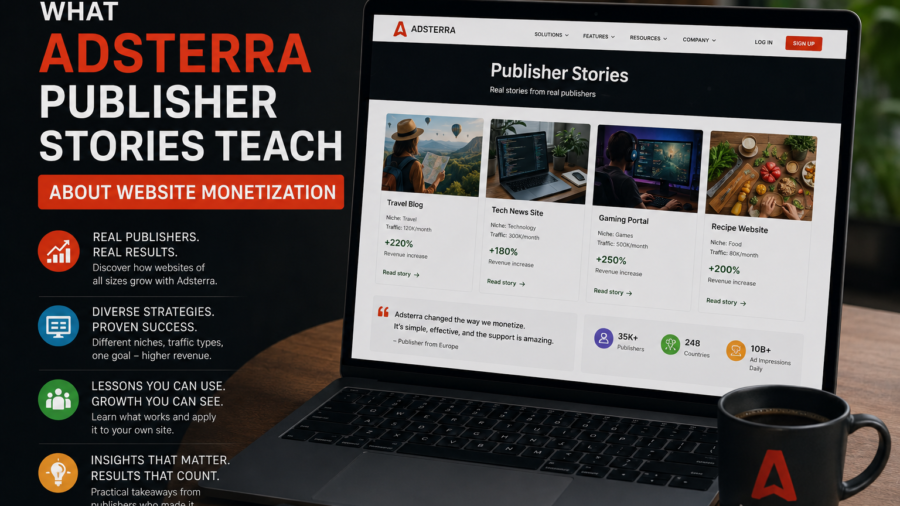
Publisher success stories are easy to misunderstand.
A headline about a website earning hundreds or thousands of dollars can sound like a shortcut. New website owners may see the number first and miss the harder part: traffic, testing, content quality, ad placement, niche choice and patience.
That is why Adsterra publisher stories are worth reading carefully.
Adsterra’s blog includes “Money Making Stories” from publishers using different types of traffic, including news sites, niche websites, Google Discover traffic and content projects from different regions. These stories can be useful, but they should not be treated as guaranteed results.
A case study is not a promise.
It is an example of what happened for one publisher under specific conditions.
For small website owners, the real value is not copying the income number. The real value is understanding what those stories usually have in common.
Disclosure: This article contains a sponsored affiliate link. If you register through the link below, we may receive a commission at no extra cost to you.
Start Monetizing With Adsterra
The First Lesson: Traffic Comes Before Revenue
The most important lesson from publisher stories is simple: ad revenue needs traffic.
An ad network cannot create an audience for a website that nobody visits. It can only help monetize the visitors a site already earns.
This is why strong publisher case studies often start with traffic strategy. Some publishers focus on Google Discover. Some use search traffic. Some build local news sites. Others work with niche entertainment, seasonal content or viral topics.
The traffic source may differ, but the basic rule is the same.
No traffic means little or no ad income.
Before expecting meaningful revenue, a publisher needs useful content, clear categories, mobile-friendly pages and a reason for readers to stay.
Ads monetize attention. Content earns that attention.
The Second Lesson: Niche Choice Matters
Not every website niche monetizes the same way.
A site about breaking entertainment news may get sudden traffic spikes. A travel guide may grow more slowly but attract readers with planning intent. A technology blog may earn search traffic from evergreen topics. A local news site may depend on fast publishing and regional interest.
Adsterra publisher stories often show that niche and audience matter as much as ad placement.
A small site in a clear niche can sometimes outperform a broad site with random content because the audience is easier to understand. Advertisers also value traffic differently depending on country, device type, topic and user behavior.
This is why publishers should avoid copying topics blindly.
A good niche should match three things: what users search for, what the publisher can produce consistently and what advertisers may value.
The Third Lesson: Google Discover Traffic Can Be Powerful, but Unstable
Some Adsterra case studies highlight Google Discover traffic.
This makes sense because Discover can bring large traffic spikes when a story matches current interest, strong visuals and mobile reading behavior. For news-style websites, Discover can be a major opportunity.
But Discover traffic is not always stable.
One article may perform well, while another may not. Trends change quickly. Visual quality matters. Titles must be interesting without becoming misleading. The site must load fast and feel good on mobile.
A publisher relying on Discover needs a steady publishing rhythm and a strong understanding of what readers are likely to tap.
The lesson is not “Google Discover will make every site money.”
The lesson is that timely, visual, mobile-friendly content can create strong monetization opportunities when traffic arrives.
The Fourth Lesson: User Experience Still Matters
Ad revenue should not destroy the page.
This is one of the most important lessons for long-term monetization. A publisher may be tempted to add more banners, more popunder ads, more interstitials and more aggressive formats to increase short-term earnings.
That can backfire.
If readers leave quickly, avoid the site or struggle to read the content, the website becomes weaker. Search traffic may suffer. Returning visitors may disappear. The brand may feel low quality.
The best publisher setups usually balance revenue and readability.
A clean article should still be easy to read. Ads should not block the headline, cover the opening section or make the page jump around. Mobile users should be able to scroll without constant interruptions.
A site that keeps readers happy has a better chance of earning steadily.
The Fifth Lesson: Ad Format Testing Is Necessary
Adsterra offers several ad formats, including popunder, social bar, in-page push, native banner, display banner and interstitial-style placements.
That does not mean every publisher should use every format.
Different formats work differently depending on niche, traffic source and user tolerance. A native banner may fit a long article better than an aggressive interruption. A popunder may perform in some niches but feel too intrusive in others. A social bar may work well on mobile for one site and annoy users on another.
The smart approach is testing.
Start with one or two controlled placements. Watch revenue, page speed, bounce behavior and mobile layout. Then adjust.
If you activate too many formats at once, you will not know which one helped or hurt.
Good monetization is measured, not guessed.
The Sixth Lesson: Mobile Traffic Is Critical
Most publisher stories today need to be understood through mobile behavior.
Readers often arrive from Google Discover, social media, messaging apps or mobile search. That means the phone experience matters more than the desktop layout.
A website owner should test every ad placement on a real phone.
Can the reader see the title quickly? Does the first paragraph appear without being blocked? Are ads too close to buttons? Does the page load smoothly? Does the layout shift while the reader scrolls?
A monetization setup that looks acceptable on desktop can feel crowded on mobile.
If the mobile experience is poor, revenue may rise briefly but long-term traffic quality can suffer.
The Seventh Lesson: Case Study Numbers Need Context
Income numbers are useful, but they need context.
A publisher earning a strong weekly or monthly amount may have high traffic volume, strong GEOs, a valuable niche, loyal readers, fast publishing, good visuals, multiple ad formats and years of experience.
A new website cannot assume the same result by adding the same ad network.
This is why income claims should be treated as examples, not guarantees.
Before judging success, ask better questions:
How much traffic did the site have?
Where did visitors come from?
Which countries generated traffic?
How long did users stay?
Which ad formats were tested?
Was the site mobile-friendly?
How often was content published?
Was the traffic seasonal or stable?
Without context, a revenue number can be misleading.
The Eighth Lesson: Referral Income Is a Separate Opportunity
Adsterra also has a referral program where publishers can earn a commission from referred publisher revenue.
This can be useful for bloggers who write about website monetization, ad networks, blogging or publisher tools. But referral income also depends on quality.
If your referrals do not earn, your commission will not mean much.
That is why referral links should be used honestly. A publisher should explain who the platform may suit, what users should test and why results depend on traffic.
Affiliate links should also be disclosed clearly and marked with sponsored attributes.
This protects trust and keeps the recommendation transparent.
How Small Publishers Can Apply These Lessons
Small publishers should start with content before ads.
Choose a clear niche. Publish useful articles. Build internal links. Improve mobile speed. Use clean images. Watch Search Console data. Identify which topics attract impressions and clicks.
Then add monetization carefully.
Start with less intrusive ad formats. Test one placement at a time. Keep the first screen readable. Avoid overwhelming mobile users. Track performance over time.
If a format increases revenue but makes the site feel worse, rethink it.
A small website grows best when content, traffic and monetization support each other.
What to Avoid
Avoid treating Adsterra or any ad network as guaranteed income.
Avoid copying case study headlines without understanding the strategy behind them. Avoid overloading new sites with ads before they have stable traffic. Avoid aggressive formats that make readers leave quickly. Avoid hiding affiliate disclosures.
Also avoid writing only for clicks.
A website can get short-term traffic from hype, but sustainable monetization usually comes from trust, consistency and useful content.
Ad networks can help, but they cannot fix weak content or poor user experience.
Final Takeaway
Adsterra publisher stories can be useful, but the real lesson is not “easy money.”
The real lesson is that website monetization depends on traffic quality, niche choice, mobile experience, ad format testing and reader trust.
Case studies can show what is possible, but they do not guarantee the same result for every site. A publisher with strong Discover traffic, a clear niche and smart ad placement may perform very differently from a new website with low traffic and random content.
If you want to test Adsterra as a publisher, you can start here:
Start Monetizing With Adsterra
The best approach is careful and realistic.
Build useful content first. Grow traffic. Test ads slowly. Protect mobile readability. Mark sponsored links properly. Then use publisher stories as learning material, not as income promises.
That is how website monetization becomes a strategy instead of a gamble.






Comments
You can write your views about this story. Comments may be moderated according to site settings.