

AI agents are becoming one of the biggest business technology trends of 2026.
They are no longer being discussed only as experimental chatbots or impressive demos. Large technology companies are now trying to connect AI agents directly to business workflows, cloud platforms and enterprise software systems.
Google Cloud and IBM have announced a strategic partnership to expand the use of AI agents for businesses. IBM said it will expand its Consulting Advantage platform with industry-specific agents for Gemini Enterprise, while a new global Google Cloud practice will bring thousands of IBM consultants to help companies scale AI and modernize core systems.
Google has also been pushing Gemini Enterprise as a platform for building, scaling, governing and optimizing AI agents. In simple terms, the goal is to help companies move from “we tested an AI tool” to “AI is helping run real business processes.”
That is why this deal matters. It shows where enterprise software is heading: toward systems where people, apps and AI agents work together across everyday business tasks.
What Google and IBM announced
IBM and Google Cloud announced a partnership focused on scaling AI with human expertise and AI-powered delivery.
IBM said the deal expands IBM Consulting Advantage, its AI-powered delivery platform, with industry-specific agents for Gemini Enterprise. The companies also said a new global Google Cloud practice will bring thousands of IBM consultants to help clients deploy AI, modernize legacy systems and manage hybrid cloud environments.
IBM described the practice as a multi-billion-dollar opportunity in Google Cloud services.
The important detail is that this is not only about giving companies access to a model. It is about helping them design, build, govern and deploy AI agents inside real business environments.
That is where many enterprise AI projects struggle.
Why enterprise AI is hard
AI is easy to demo but hard to deploy.
A chatbot can answer a question in a controlled test. A business system is much more complicated. It may include customer records, financial data, supply chains, internal approvals, compliance rules, employee permissions and old software that still runs critical operations.
Many companies want AI, but they do not know how to connect it safely to existing systems.
This is why IBM’s consulting role matters. Enterprise customers often need help with planning, data readiness, security, workflow design, governance and change management.
Google can provide models, cloud infrastructure and agent-building tools. IBM can provide industry knowledge and implementation support.
Together, the companies are trying to solve a practical problem: how to make AI agents useful inside companies that cannot simply replace all their old systems overnight.
What AI agents actually do
An AI agent is different from a basic chatbot.
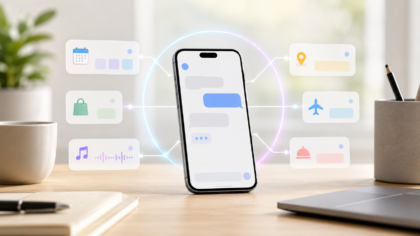
A chatbot usually responds to a single request. An AI agent can plan steps, use tools, connect to software and help complete a task over time.
For example, a simple chatbot can explain a company policy. An AI agent could read a request, check the relevant policy, pull information from a database, prepare a response and route the case to the right department.
In business settings, AI agents may help with customer service, HR processes, IT support, procurement, finance operations, sales workflows, compliance checks or document processing.
The key idea is not that AI replaces all workers. The practical goal is often to reduce repetitive work and help people complete tasks faster.
Why industry-specific agents matter
Generic AI is useful, but businesses often need more specific tools.
A bank has different needs from an airline. A hospital has different rules from a retailer. A manufacturer has different workflows from an insurance company.
That is why IBM and Google are talking about industry-specific agents.
An agent built for retail might help with inventory, product recommendations or customer support. An agent built for banking might support compliance reviews, document handling or internal service requests. An agent built for manufacturing might help with maintenance data or supplier workflows.
The more specific the workflow, the more valuable the agent can become.
But specificity also increases responsibility. A business AI agent must understand limits, permissions and risk. It cannot behave like a casual consumer chatbot.
Why governance is central
Enterprise AI needs governance.
That word can sound boring, but it is essential. Governance means companies need to know who can use an AI agent, what data it can access, what actions it can take, how decisions are logged and how mistakes are reviewed.
Google says Gemini Enterprise Agent Platform is designed to help build, scale, govern and optimize agents. That governance layer matters because companies cannot allow AI agents to freely access sensitive systems without control.
If an AI agent can approve expenses, change customer records or trigger workflows, businesses need audit trails and permission systems.
The future of enterprise AI will not be judged only by intelligence. It will be judged by trust, control and reliability.
Why this matters for workers
For employees, AI agents could change daily work.
Instead of searching through dashboards, forms and internal documents, workers may ask an AI agent to help complete a process. The agent might find the right file, summarize a policy, prepare a draft or suggest the next step.
This could save time, especially in large organizations where information is spread across many systems.
But workers may also worry about automation. If AI agents handle more tasks, some roles may change. Repetitive administrative work could shrink, while oversight, exception handling and decision-making become more important.
The most realistic near-term outcome is not that AI agents replace entire departments overnight. It is that they become assistants inside existing workflows.
Companies that use them well will likely focus on human review and clear responsibility.
Why this matters for software companies
The Google-IBM deal also shows how enterprise software competition is changing.
For years, business software was mostly about databases, dashboards, workflow tools and cloud subscriptions. Now the next layer is AI agents that sit on top of those systems.
Microsoft is pushing Copilot and personal agents into Microsoft 365. Salesforce has been building agent tools for customer workflows. ServiceNow is adding AI to enterprise service management. Google wants Gemini Enterprise to become a major platform for business agents.
This means the software battle is moving from “which app do you use?” to “which AI layer helps you work across apps?”
That is a major shift.
The role of consultants in the AI agent era
Some people assume AI will reduce the need for consultants. In the short term, the opposite may happen.
Companies need help deciding which workflows should use AI, how to prepare data, how to manage risk and how to measure results. They also need help connecting new AI tools to old systems.
This is why IBM’s consulting business is important in the partnership.
Enterprise AI is not plug-and-play for most large organizations. It requires planning, migration, security and training. Consultants may help companies move beyond small pilots into production systems.
The success of AI agents may depend as much on implementation as on model quality.
What ordinary readers should take away
This may sound like a business technology story, but it affects everyday services too.
When banks, airlines, retailers, hospitals, insurers or government contractors adopt AI agents, customers may notice faster responses, more automated support and more personalized service.
They may also notice new frustrations if automation is poorly designed.
A good AI agent can reduce delays. A bad one can trap users in a support loop. That is why businesses need human fallback, clear accountability and strong data protection.
Enterprise AI should make services easier, not less human when human help is needed.
The bigger takeaway
Google and IBM’s AI agent partnership shows that enterprise software is entering a new phase.
AI is moving from isolated chat tools into workflows, cloud platforms and business operations. Companies do not only want AI to answer questions. They want it to help complete tasks.
That is a much bigger challenge.
To succeed, AI agents need industry knowledge, secure data access, workflow integration, governance and human oversight. That is why partnerships between cloud providers and consulting firms are becoming more important.
The future of enterprise software may not be one app replacing another. It may be an AI agent layer that connects many systems and helps people work across them.
Google and IBM are betting that businesses are ready for that next step.





Comments
You can write your views about this story. Comments may be moderated according to site settings.