
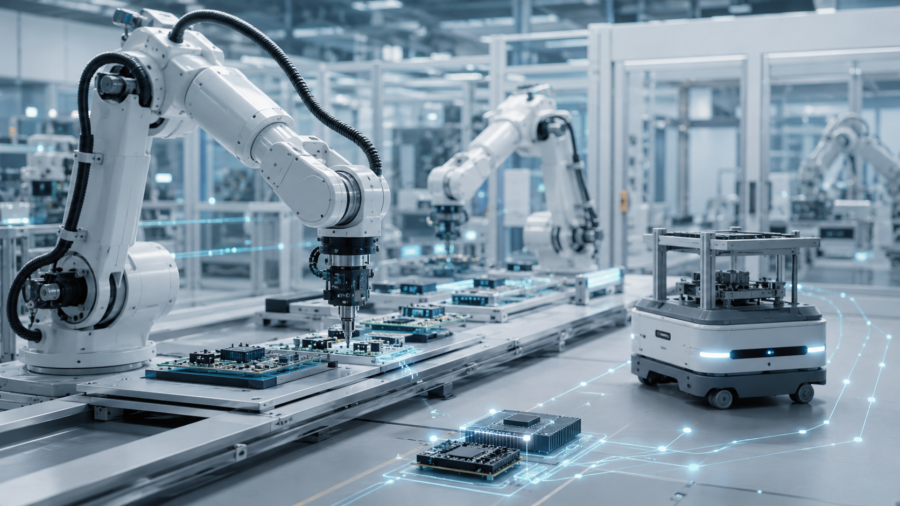
Artificial intelligence is moving out of chat windows and into the physical world.
That is the bigger message behind Nvidia CEO Jensen Huang’s latest comments in South Korea. According to Reuters, Huang said he sees robotics as South Korea’s next major sector during a visit to the country. He also had meetings planned with major Korean companies including Hyundai Motor, LG, SK Hynix, Samsung Electronics and Naver.
This is not only a story about one CEO’s travel schedule. It points to a larger business shift: AI is becoming closely connected with robotics, manufacturing, chips and smart factories.
South Korea is well positioned for that shift because it already has strong industries in semiconductors, electronics, vehicles, batteries and advanced manufacturing. Nvidia sees an opportunity where those strengths meet AI.
Why robotics is becoming an AI business
Robotics used to be seen mostly as an industrial hardware field. Robots worked in factories, moved parts, welded metal or handled repetitive tasks.
AI changes that.
A robot with better AI can understand its environment, respond to changes, learn from data and work more safely around people. Instead of only repeating programmed movements, future robots may be able to adapt to more complex tasks.
This is why robotics is now becoming part of the AI business story.
Companies do not only need mechanical arms. They need sensors, chips, AI models, simulation tools, software, data centers and factory integration. That creates opportunities for chip companies, cloud providers, manufacturers and industrial software firms.
Nvidia’s interest makes sense because modern robotics needs powerful computing. Robots may need AI chips to process camera data, understand objects, plan movement and coordinate with factory systems.
Why South Korea is important
South Korea has several strengths that make it attractive for robotics and AI factories.
First, it has world-class manufacturing companies. Samsung Electronics and SK Hynix are major players in memory chips, which are critical for AI systems. LG has broad electronics, display, battery and appliance expertise. Hyundai Motor has deep automotive and mobility experience.
Second, South Korea has a strong industrial base. Robotics is easier to scale when there are real factories, suppliers and production lines that can use the technology.
Third, South Korea has a culture of advanced consumer electronics and automation. That matters because robots are not only hardware. They need software, sensors and connected systems.
Reuters reported that Huang described Korea’s mix of manufacturing, mechatronics and AI as ideal for robotics development. That combination is exactly what the next generation of industrial AI requires.
What Nvidia gets from robotics
Nvidia is best known for AI chips used in data centers, gaming PCs and professional computing. But robotics is a natural extension of its AI strategy.
Robots need many of the same things that AI systems need: processors, simulation environments, software frameworks and model deployment tools.
Nvidia already has platforms for robotics, autonomous machines and digital simulation. Its business opportunity is not only selling chips to data centers. It can also sell the hardware and software stack that helps companies build AI-powered robots and smart factories.
That is why South Korea matters. If Nvidia can work closely with Korean industrial giants, it can push AI deeper into manufacturing, vehicles, electronics and robotics.
In simple terms, Nvidia wants its AI technology to power machines that act in the real world, not only models that answer questions online.
Why Hyundai, Samsung, LG and SK Hynix matter
The list of companies Huang planned to meet is important.
Hyundai Motor connects robotics with vehicles, mobility and smart factories. The company has already shown interest in robotics through automation, future mobility and advanced manufacturing.
Samsung Electronics and SK Hynix matter because AI hardware depends heavily on chips and memory. AI systems need fast memory and advanced semiconductor production. Robotics and AI factories will also require efficient computing inside industrial environments.
LG brings electronics, appliances, batteries and factory technology into the conversation. Naver adds software, cloud and AI services.
Put together, these companies cover much of the robotics stack: chips, manufacturing, vehicles, software and connected devices.
That is why Nvidia’s South Korea push is more than a normal business trip.
What are AI factories?
Nvidia often uses the phrase “AI factory” to describe infrastructure that produces intelligence instead of physical goods.
In a traditional factory, raw materials go in and products come out. In an AI factory, data and computing power go in, and AI models, predictions or automated decisions come out.
But in robotics, the idea can become more literal.
A smart factory may use AI to manage production lines, inspect products, control robots, predict equipment failures and optimize energy use. The same factory may also generate the data needed to improve future robot behavior.
This creates a loop: factories use AI to become more efficient, and those factories produce more data to improve AI systems.
That is one reason Nvidia sees robotics and manufacturing as closely connected.
Why this matters for ordinary readers
Robotics may sound distant, but it can affect daily life in practical ways.
AI-powered robots could help make factories more efficient, which may affect product availability and manufacturing costs. They could support warehouse automation, home appliances, healthcare tools, delivery systems and future vehicles.
They may also change jobs.
Some repetitive tasks could become more automated. At the same time, companies may need more workers who can manage, maintain and supervise robotic systems.
The shift will not happen overnight. Industrial robotics is complex, expensive and safety-sensitive. But the direction is clear: AI is making robotics more important to the global economy.
Why this is a business story, not only a tech story
Robotics sits at the intersection of technology and industry.
A chatbot can launch as a software product. A robot must work in the real world. It must handle physical spaces, safety rules, mechanical limits and unpredictable situations.
That makes robotics harder, but also potentially valuable.
If AI-powered robots can improve manufacturing productivity, reduce downtime or help with labor shortages, companies will pay attention. Countries with strong manufacturing bases may also see robotics as a way to stay competitive.
This is why South Korea is such an important market. It has the industrial depth to test and scale real robotics applications.
What could slow the robotics boom
There are still major challenges.
Robots are expensive to design and deploy. They need reliable hardware, careful safety testing and integration with existing factory systems. AI models also need to be trustworthy in physical environments because mistakes can cause real damage.
Another challenge is standardization. A robot built for one factory task may not easily work in another factory. Customization can raise costs.
There are also workforce concerns. Automation can improve productivity, but companies and governments need to plan for worker training and job transitions.
So while robotics has major potential, it will not scale as easily as a mobile app.
The bigger takeaway
Nvidia’s view that robotics could become South Korea’s next major AI sector shows how the AI race is expanding.
The first wave of AI attention focused on chatbots, cloud models and data center chips. The next wave may involve factories, robots, vehicles and industrial automation.
South Korea has the ingredients for that shift: semiconductor strength, advanced manufacturing, electronics giants and major automotive players. Nvidia has the AI hardware and software stack that could support it.
The result could be a deeper connection between AI and the physical economy.
For ordinary readers, the key point is simple: AI is no longer only something you type into. Increasingly, it is something that could help machines see, move, build and work in the real world.



Comments
You can write your views about this story. Comments may be moderated according to site settings.